Food Cutting
A titanium blade vibrating at ultrasonic frequency parts the product instead of squeezing it — clean faces on sticky, layered and frozen food, almost no residue on the blade, and wash-down measured in minutes.

Cutting food is a fight against three enemies
A conventional blade squeezes layered products, product builds up on the edge, and every sticky slice drags the cut face apart. Ultrasonic cutting removes the fight by removing most of the contact force.
Driven at typically 20 kHz, the blade vibrates 20 000 times a second with an amplitude measured in microns. The edge does not press through the product — it micro-vibrates through it, breaking blade-to-food contact on every cycle. Friction drops sharply, so the product is parted rather than squeezed.
The blade vibrates before contact, so soft products are not squashed at first touch. Softer foods and mixed textures — nougat, soft cheese with nuts, layered sandwiches, cakes — run at higher amplitude; firm products run at lower amplitude and get correspondingly longer blade life.
- Layers stay where they were baked, fillings stay centred
- Frozen products cut straight from cold storage — no thaw step, no melt edge
- Sticky chocolate, caramel and gummy release cleanly, no stringing
What ultrasonic food cutting handles
Real products, grouped the way our customers ask for them — 23 proven uses across 5 categories. Your product not listed? If it responds to ultrasonics, we test it free.
Frozen Products
- Frozen salmon & fish fillets — portioning without tearing flesh
- Frozen meat blocks and portion-controlled cuts
- Ice cream — bars, sandwiches and tub-portioned blocks
- Frozen cakes, cheesecakes and dessert slabs
- Frozen dough and par-baked goods
Sticky & High-Viscosity
- Chocolate — blocks, bars and coated products, no melting or bloom
- Gummy candy, marshmallow and jelly — edges set neat, no stringing
- Nougat, toffee and caramel — the classic sticky problems, solved
- Protein, granola and cereal bars with nuts & fruit inclusions
- Peanut brittle and hard-candy slabs
Bakery & Multi-Layer
- Cream cakes, mousse and cheesecake — layers stay sharp, fillings don’t squeeze out
- Swiss rolls, brownies and pastries
- Sandwiches, wraps and burgers — bread and fillings hold shape
- Pizza slices, focaccia and flatbread portions
- Sushi rolls and spring rolls — flat faces, no sticking
Cheese, Dairy & Deli
- Soft and semi-hard cheese — blocks, wedges and portions with closed faces
- Butter and butter-blend portions
- Ham, sausage and deli meats — fewer crumbs, smoother slices
- Tofu and paneer — shape held, no crumbling
Fruit, Vegetables & Pasta
- Soft fruits — mango, kiwi, strawberry, with minimal juice loss
- Crisp vegetables — cucumber, celery, carrot, no shattering
- Layered pasta sheets and lasagna
- Filled products — jams, creams and nut-filled items stay in place


Six reasons, each one a fact you can check on your own product
Nothing sticks to the blade
40 kHz vibration prevents adhesion, so sticky chocolate, caramel and cheese release cleanly — the blade stays clean for hours, not minutes.
No crushing, no smear
Cutting force drops dramatically versus a static knife. Layers stay separated, fillings stay centred, faces stay smooth.
Cold process for frozen goods
No friction heat — frozen salmon, ice cream and frozen cakes are portioned straight from cold storage, with no thaw step and no melt-edge waste.
Sharper faces, less giveaway
A thin kerf and exact portions mean more sellable units per batch — and slices that look as good on day three as off the line.
Faster hygiene cycles
Less product build-up means shorter wash-downs, and food-grade stainless and titanium tooling that meets batch-production hygiene standards.
Built for the line
Single or multi-blade heads, servo-controlled speed and position, and integration into automated slicing lines for continuous output.
The same technology, three formats
Blades mount vertically, horizontally or continuously for roller cutting, depending on how your product flows.

Handheld cutting wand
For bakeries and small producers, and for prototyping cuts before committing to a line.
Small batches · sampling · R&D
Semi-automatic station
Single or multi-blade head on a bench or rotary table — the operator loads, the cut repeats identically every cycle.
Medium volume · repeated formats
Automated slicing line
Line-mounted heads with servo-controlled speed and position for continuous output, or robot-arm mounting for shaped cuts.
Continuous production · OEM linesBlades & tooling
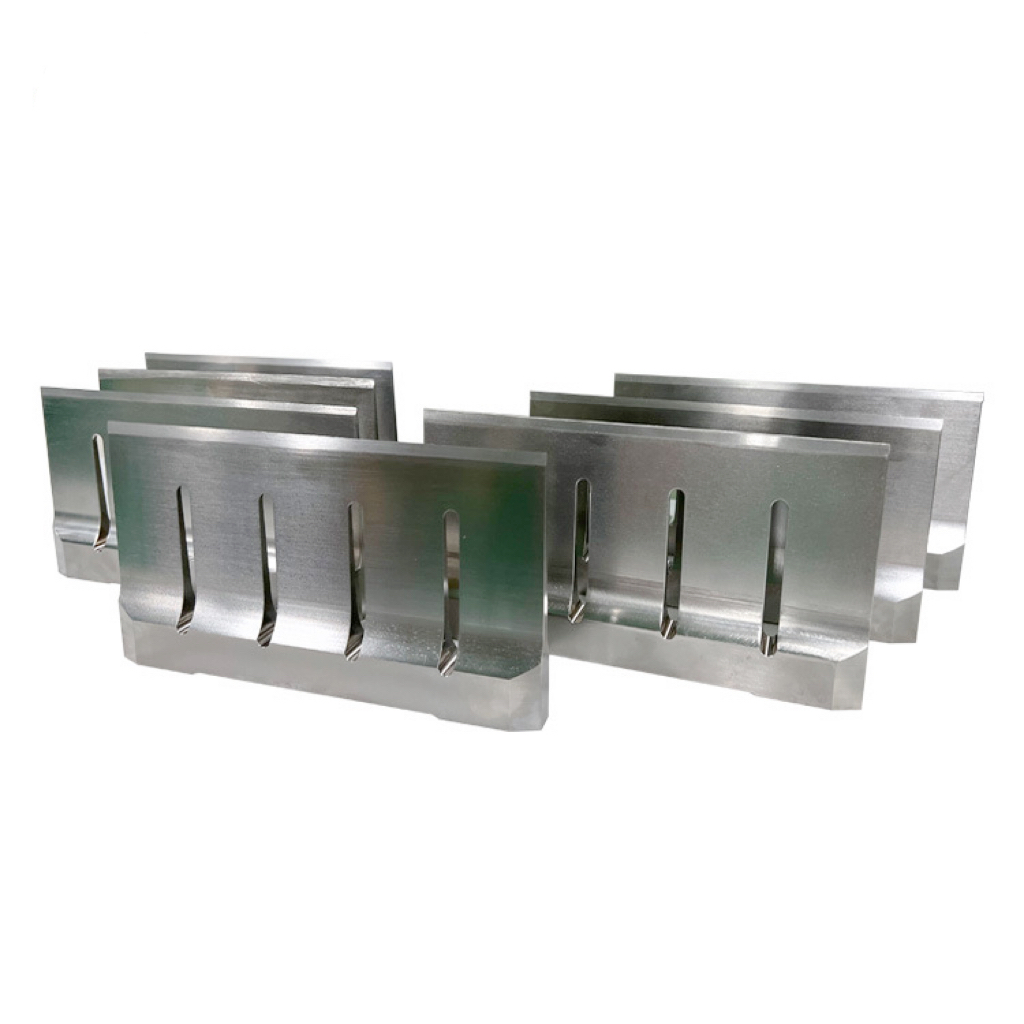
Every blade is machined from food-grade titanium — resonance, fatigue resistance and sanitary compatibility in one material. Profiles are wire-EDM cut and then stress-relieved, which maximises tool life under high cyclic stress.
Each blade is tuned to your generator frequency: mass, length and geometry are calculated, not guessed. When performance eventually drops we re-tune or replace the blade — ultrasonic blades are never ground or re-sharpened.
- Standard lengths 70–350 mm; 20 kHz 150 mm covers most food and rubber cutting
- Square, slit, chevron and custom profiles; 28–40 kHz sizes available
- Fully sealed converter, wash-down rated for wet food environments
- Supplied loose for your existing machine, or as a matched blade + booster + generator set


Ultrasonic cutting vs a conventional blade
Ultrasonic wins where edge quality, cleanliness or material sensitivity matter. Where a rough cut is acceptable, a mechanical blade remains cheaper — tell us the material and the edge requirement and we will say honestly which side of that line your product is on.
| Criterion | Ultrasonic cutting | Conventional blade |
|---|---|---|
| Cutting force | Very low — the product is parted, not squeezed | High — compression on every cut |
| Sticky products | Chocolate, caramel and gummy release cleanly | Build-up on the edge, stringing, drag marks |
| Layered products | Layers stay separated, fillings stay centred | Layers squeeze and smear together |
| Frozen products | Cut straight from cold storage, no thaw step | Thaw needed, or a ragged melt edge |
| Thin slices | Practical without tearing | Tends to tear soft products |
| Cleaning time | 70–90% shorter wash-down | Frequent stops to clear the blade |
| Tool cost | Higher tooling cost | Cheapest option |
Equipment we specify most often
Full specifications and inquiry forms are on each product page.


How to prove it on your product
Cut behaviour is product-specific — density, temperature, inclusions and layer structure all matter. So we cut your product before you buy anything.
Send your product
A sample, or its photo and dimensions, plus the temperature and cut width you need.
We cut it on camera
You get the video, cut-face photos and the frequency, amplitude and blade geometry we recommend.
System ships, tuned
Blade, booster and generator are delivered matched and tested, with the test-cut samples.
Questions buyers ask before ordering
Can I buy just the blade for my existing machine?
Yes — we supply replacement titanium blades machined and tuned to your existing cutting-head frequency.
Do blades need re-sharpening?
No conventional sharpening. When performance drops we re-tune or replace the blade rather than grind it.
How often do blades need replacing?
Blade life varies with the product and the duty cycle; they are rebuildable, and we re-tune or replace them as needed.
What's the MOQ for custom profiles?
Tell us the profile and the quantity. Custom titanium blades are made to order with a low minimum order.
Handheld or robot-mounted?
Both use the same generator, transducer and blade. Handheld wands suit bakeries and small batches, bench stations suit repeated formats, and line or robot-mounted heads suit continuous production.
What do you need from us for a custom blade?
The product itself, or its photo and dimensions, plus the temperature and cut width. We cut-test it and come back with blade geometry and frequency.
Other applications
Not Sure If It Works for Your Product?
Cut behaviour depends on density, temperature, inclusions and layer structure — so send us the product. We cut it on camera and return the video, cut-face photos and recommended parameters within one working day.
Send Your Product — We Cut It on Camera