Ultrasonic Metal Spot Welding Machine
A pneumatic ultrasonic spot welder for copper, aluminium, brass, nickel and plated surfaces — 15 or 20 kHz, 3000 to 6000 W and up to 50 mm of weld area, bonded in a fraction of a second without solder, flux or shielding gas.

Spot welds that keep the conductivity intact
An ultrasonic metal spot welding machine joins metal parts by pressing them together under a horn vibrating at high frequency. The vibration breaks up surface oxides and bonds the parts below melting point, so there is no filler wire, no flux, no shielding gas — and no spatter to clean off the terminal afterwards.
That matters wherever the joint has to carry current: the weld is a solid-state bond, so contact resistance stays low and the metal around the joint is not annealed. Plated and oxidised surfaces weld without pre-cleaning, and a weld cycle takes a fraction of a second.
Six things buyers check on a spot welder
High-quality transducer
A well-built ultrasonic transducer gives strong output and stable running through a full shift.
Conductivity almost unchanged
The joint keeps good conductivity — contact resistance is very low, close to zero.
Oxidised or plated metal welds
Oxide layers and plated surfaces can be welded directly, without pre-cleaning or special preparation.
Short cycle, no consumables
Weld time is short and there is no flux, gas or solder to buy, store or clean up.
No sparks, safer floor
No welding sparks and no fumes — safer for the operator and cleaner than arc or resistance welding.
Stepless amplitude adjustment
Amplitude is adjusted steplessly, so there is no need to keep swapping amplifiers to suit different parts.
Ultrasonic Metal Spot Welding Machine — specification
The figures below are our standard configuration. Frequency, power, horn and anvil are matched to the joint you are making: 20 kHz with lower power suits small terminals and thin foil, while 15 kHz with 6000 W handles larger cross-sections and denser stacks.
Send us the material, thickness and joint size and we trial-weld your samples, then confirm the configuration and tooling before you order.
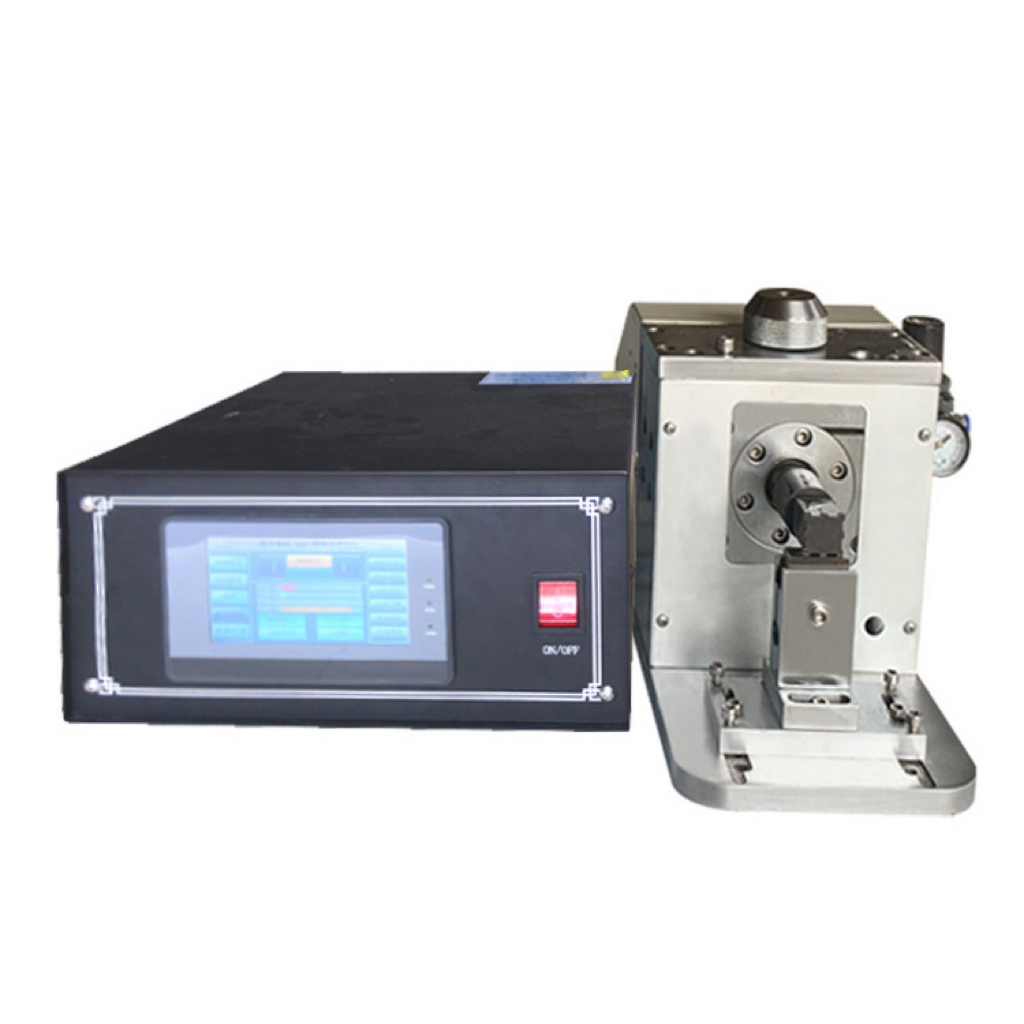
Ultrasonic Metal Spot Welding Machine — specification
| Item | Value |
|---|---|
| Product name | Ultrasonic Metal Spot Welding Machine |
| Frequency | 15 kHz, 20 kHz |
| Power | 3000 W, 4000 W, 6000 W |
| Welding area | 0 – 50 mm |
| Drive | Pneumatic |
| Working voltage | AC 220 V / 50 Hz |
| Working air pressure | 0.5 – 0.7 MPa |
| Size | 385 × 525 × 135 mm |
| Welding material | Copper, aluminium, brass, nickel, stainless steel, titanium and plated metals |
| Consumables | None — no flux, gas or solder |
| Warranty | One year warranty with lifetime support |
Seven material groups this machine handles
Metals
Aluminium, copper, brass, stainless steel, nickel alloys, titanium, mild steel and zinc-coated steel.
Metal Alloys
Alloys used in aerospace and automotive work, welded without melting the base material.
Battery Tabs
Metal tabs and connectors in lithium-ion and other battery types.
Electrical Contacts
Contacts and connectors in electronics and electrical components, where solder heat is a risk.
Sheet Metal
Thin sheet components in automotive and appliance manufacturing.
Wire and Ribbon
Thin wires and ribbons used in electronics and electrical assemblies.
Metal Foils
Foil joining for aerospace, medical and battery applications.


Suitability depends on material thickness, conductivity and the joint strength you need. Welding parameters are adjusted per material — send us your parts and we confirm the settings on a free sample test.
Assembled and tuned in our own workshop


Questions buyers ask before ordering
Can you weld my sample first?
Yes. Send us your terminals, tabs or sheet samples and we weld them in our application lab, then return the tested parameters with photos and, if you need it, pull-test results.
15 kHz or 20 kHz — which do I need?
20 kHz suits small terminals, thin foil and delicate parts; 15 kHz carries more energy for larger cross-sections. Tell us the material and joint size and we recommend the match.
Can it weld oxidised or plated surfaces?
Yes — oxides and plating can be welded directly without pre-cleaning, which is one of the reasons ultrasonic welding is used on electrical contacts.
What about tooling and lead time?
Horn and anvil are machined in-house to your joint geometry. Standard configurations ship fastest; custom power, frequency or tooling adds engineering time, quoted with the configuration.
Other metal welding systems


Send us your metal parts for a free weld test
Tell us the material, thickness and joint size. We weld your samples in our application lab and return the recommended frequency, power and tooling — usually within 2–3 working days.
Request a Quotation